
Who Invented Artificial Intelligence: Complete History
Explore who invented artificial intelligence via four milestones: McCulloch and Pitts, Turing, the Dartmouth workshop, and the first working programs.
ARTIFICIAL INTELLIGENCETOP BLOGS
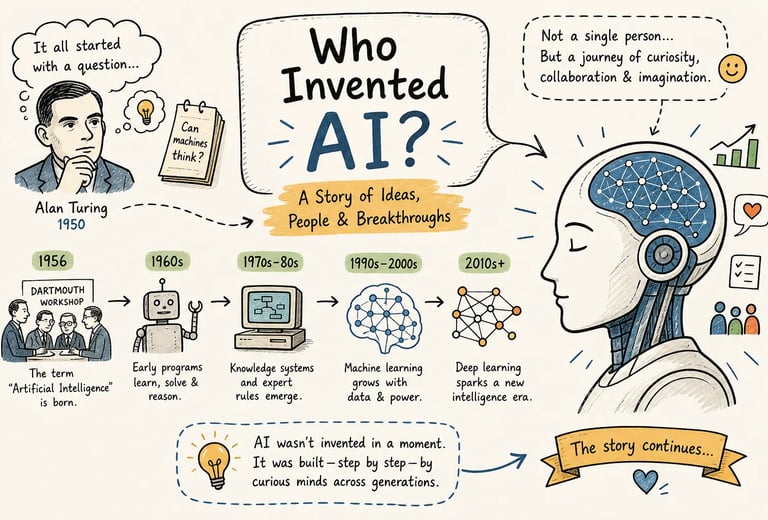
Who Invented Artificial Intelligence? A Complete History
When people ask who invented artificial intelligence, they expect a name. One person, one moment, one genius-in-a-garage story. What they get instead is something far more interesting: a chain of thinkers across three decades who weren't always aware they were building the same thing, passing ideas between disciplines like a relay baton, each contribution incomplete without the next.
That absence of a single inventor is not a gap in the historical record, it is the most important thing about how AI came to exist. Genuinely transformative ideas rarely arrive fully formed. They accumulate across generations, collide between disciplines, and compound in ways their originators never anticipated.
This article traces four intellectual pillars: the 1943 neural model that planted the first seed, Turing's 1950 philosophical challenge that reframed the question entirely, the 1956 Dartmouth workshop where the term "artificial intelligence" was formally coined, and the first working programmes that proved machines could actually reason. Understanding where AI began shapes how you understand everything it is becoming now, including the quiet intelligence that helps plan holidays with an accuracy that would have seemed like science fiction to McCarthy's generation.
Who invented artificial intelligence: key milestones and the figures behind them
If you want to understand who invented artificial intelligence, the honest answer is that no single person did. The question resolves, instead, into a sequence of decisive contributions, each one necessary, none sufficient alone. What follows traces that sequence from its earliest roots.
Before anyone said "AI": the 1943 paper that planted the first seed
Twelve years before the phrase "artificial intelligence" existed, two researchers published a paper on how neurons in the brain might work and, in doing so, laid the foundation for everything that followed. Neither of them set out to build thinking machines. They were trying to understand the mind.
The mathematical neuron McCulloch and Pitts introduced
Warren McCulloch was a neuroscientist; Walter Pitts was a self-taught logician who had taught himself Greek at the age of twelve and arrived at the University of Chicago having already read Bertrand Russell. In 1943, they published "A Logical Calculus of the Ideas Immanent in Nervous Activity," proposing something quietly revolutionary. A neuron, they argued, receives inputs, sums them up, and fires only if that sum exceeds a threshold. The model was deceptively simple, yet it was both powerful and, crucially, logical in its structure. By connecting these binary units in different configurations, McCulloch and Pitts demonstrated that their model could perform every logical function, including AND, OR, and NOT. A network of neurons was, at its root, a reasoning machine.
Why a paper on nervous activity still matters to computer science
The downstream influence of this paper is difficult to overstate. It directly inspired Marvin Minsky to build the SNARC neural network in 1951, and it influenced John von Neumann's thinking on computer architecture. It gave later researchers a formal vocabulary for approaching machine reasoning, a vocabulary whose intellectual lineage can be traced from that 1943 paper through Rosenblatt's perceptrons, through the deep learning revolution of the 2010s, and into the transformer models powering large language systems today. The McCulloch and Pitts paper is the quiet origin story most people skip over in the history of AI, yet every modern neural network architecture, from convolutional networks to large language models, claims it somewhere in its intellectual genealogy.
Alan Turing's question that changed the entire conversation
While McCulloch and Pitts gave AI its biological metaphor, Alan Turing gave it its philosophical challenge. In 1950, he published "Computing Machinery and Intelligence", a paper that reframed the question entirely. Not "can machines think?" but "can a machine behave indistinguishably from a human?" That shift mattered more than it might seem, because it moved the definition of intelligence from the internal to the observable.
The imitation game and what it was really asking
Turing proposed the imitation game, now known as the Turing Test. The logic was elegant: if a machine could hold a conversation convincingly enough to fool a human judge, it deserved to be called intelligent. Turing argued that intelligence should be judged by behaviour, not by internal mechanics. He even made a specific prediction: by the year 2000, machines with around 100 MB of storage would be able to pass this test 30% of the time. He was broadly right about the direction, if slightly optimistic about the timeline.
The child machine: Turing's quiet theory of machine learning
Less famous but equally important was an idea Turing had outlined two years earlier, in his 1948 report "Intelligent Machinery." He proposed that building a programme to simulate an adult mind was less effective than creating a simpler "child machine" that could be educated over time. By 1950, he had crystallised this into a single sentence: "what we want is a machine that can learn from experience." Turing's place in the origins of AI is not reducible to the Turing Test alone. His 1948 report represents one of the earliest and most influential articulations of machine learning as a concept, a vision that predates Arthur Samuel's coining of the term itself by more than a decade, and it laid out the entire framework of machine cognition that his contemporaries were only beginning to glimpse. For an accessible overview of his broader impact, see Alan Turing's everlasting contributions to computing, AI and cryptography.
Who invented artificial intelligence: the Dartmouth workshop of 1956
If McCulloch and Pitts lit the fuse, and Turing asked the defining question, the summer of 1956 was when the whole enterprise was formally named and organised into a field. Historians often call the Dartmouth workshop the "Constitutional Convention of AI," and the comparison holds. It did not produce a single breakthrough paper. What it produced was something more durable: a shared framework, a shared vocabulary, and a shared conjecture.
John McCarthy and why he coined the term
John McCarthy was the primary organiser and the man who named the field. In a funding proposal to the Rockefeller Foundation dated August 1955, he first used the phrase "artificial intelligence," defining it as "the science and engineering of making intelligent machines." His co-organisers were Marvin Minsky, Nathaniel Rochester, and Claude Shannon, four figures who between them spanned computer science, neuroscience, mathematics, and information theory. McCarthy went on to develop the Lisp programming language in 1958, which became the foundational tool for AI programming for decades. McCarthy's claim to being a founder of AI rests on more than coining a term: he assembled the community around that term, gave it direction, and built the practical tools that made symbolic AI possible.
What the Dartmouth workshop of 1956 actually produced
The workshop ran for eight weeks at Dartmouth College in New Hampshire. McCarthy later recalled the atmosphere as stimulating rather than conclusive, few formal papers emerged. What the workshop established, instead, was a conjecture that became the bedrock of all subsequent research: that every aspect of learning or intelligence can be described precisely enough for a machine to simulate it. That conjecture pulled together researchers from mathematics, computer science, neuroscience, and psychology into a single intellectual project for the first time. It was the moment AI stopped being a collection of separate ideas and became a discipline.
The first AI programmes and the builders who wrote them
By December 1955, a working AI programme already existed. It was called the Logic Theorist, and it had been built not at Dartmouth but at the RAND Corporation in Santa Monica. The programme could prove mathematical theorems from Bertrand Russell and Alfred North Whitehead's Principia Mathematica through automated reasoning, not brute-force calculation. It proved 38 of the 52 theorems it was given, and in several cases found proofs simpler than the originals.
Newell, Simon, and Shaw: three names the history books underplay
The team behind Logic Theorist was Allen Newell, a computer scientist; Herbert A. Simon, an economist and political scientist; and Cliff Shaw, a systems programmer who wrote the actual code. Newell was explicit about Shaw's contribution: "Cliff was the genuine computer scientist of the three." The programme was presented at the Dartmouth Workshop to a reception that Simon himself later described as underwhelming, McCarthy and Minsky were not yet convinced of its significance. Simon, characteristically undeterred, predicted that within ten years a computer would be the world chess champion. He was off by about forty years, but the direction was entirely correct.
Why the Logic Theorist matters beyond its theorems
Before Logic Theorist, AI was a collection of ideas about what machines might one day do. After it, AI was also a working programme demonstrating that machines could exhibit novel, intelligent behaviour in the present tense. That distinction carries weight when considering who founded AI: it was never one person, but a relay race of ideas that required both the philosophers and the engineers to make something real. Turing asked the question; McCulloch and Pitts built the biological metaphor; McCarthy named the field; Newell, Simon, and Shaw provided the proof of concept.
From research labs to the world we live in now
The seventy years between 1956 and 2026 trace a path that the Dartmouth participants could only partially anticipate. Expert systems dominated the 1970s and 1980s, demonstrating that machines could encode specialist knowledge. AI winters followed, periods when funding contracted sharply as early promises outran results.
The revival came in stages. Deep belief networks and improved training methods in the mid-2000s breathed new life into neural network research. The 2010s brought a step change: the 2012 ImageNet competition demonstrated that deep convolutional networks could match and then surpass human performance on image recognition tasks, triggering a wave of commercial investment. Large language models emerged in the 2020s as perhaps the most significant inflection point since the Dartmouth workshop itself.
How AI moved from academic curiosity to industrial backbone
The progress from Logic Theorist's 38 theorem proofs to models that can write legal briefs, compose music, or analyse medical images represents seventy years of accumulated intellectual inheritance, each layer building on what McCulloch, Turing, McCarthy, and the others started. AI is now embedded in search engines, financial systems, medical diagnostics, and content creation. The child machine Turing imagined has, in a sense, grown up.
The quiet intelligence now shaping how we travel
AI has transformed travel planning just as thoroughly as it has transformed healthcare or finance. Where travel agencies once relied on brochures, phone calls, and consultant memory, they now draw on recommendation engines, preference-matching algorithms, and dynamic itinerary tools to serve travellers with a level of personalisation that would have taken days to compile manually. At Skylord Cruise and Holidays, we use technology-enabled tools to match travellers to the right cruise routes, destinations, and experiences, a Caribbean cruise suited to a retired couple's pace, or a multi-centre itinerary built around a family's particular interests. It is a practical illustration of how the ideas that began in McCulloch's threshold neurons and McCarthy's Dartmouth workshop now shape something as everyday as planning a holiday.
Why no single inventor, and what that teaches us about how ideas are born
Return to the central question and the answer becomes clear. The reason there is no single inventor of AI is not because the history is murky or incomplete. It is because AI, like most profound intellectual achievements, required a chain of contributors across generations, each building on what came before, each contribution necessary but none sufficient alone.
The relay race model of intellectual progress
McCulloch and Pitts gave AI its biological metaphor in 1943. Turing gave it its philosophical challenge in 1950. McCarthy gave it its name and its first organised community in 1955 and 1956. Newell, Simon, and Shaw gave it its first working proof of concept. Each of these contributions materially shaped the development of AI; without them, the field might have emerged later, or in a very different form. The origins of artificial intelligence are not a story of lone genius. They are a story of distributed, cross-disciplinary thinking accumulating critical mass over time.
What the origins of artificial intelligence tell us about the future
The history of AI offers a reassuring pattern for anyone watching the current acceleration of machine intelligence with some anxiety. The next leap will also not come from a single genius in a single room. It will come from the same kind of collaborative, multi-disciplinary thinking that carried AI from a 1943 neuroscience paper to the age of generative models. The most consequential ideas tend to work this way: incremental and invisible for long stretches, then transformative almost without warning, assembled from many minds across many years.
Many people worry that their jobs will be lost to AI. This is a justified concern as people see more and more basic and clerical led tasks in businesses taken over by automation.
The full picture: who invented artificial intelligence
So, who invented artificial intelligence? By now, the question itself feels like the wrong shape. AI has no single inventor because it was never a single invention. It is a living intellectual project, still unfinished, still accumulating contributors.
The key figures deserve naming one final time. McCulloch and Pitts built the neural model in 1943 that gave AI its computational vocabulary. Alan Turing posed the defining question in 1950 and articulated the vision of machine learning before the term existed. John McCarthy named the field, organised the Dartmouth workshop in 1956, and built the programming tools that made symbolic AI possible. Allen Newell, Herbert Simon, and Cliff Shaw wrote the Logic Theorist, the first programme that proved machines could reason in practice, not just in theory. Together, they form the origins of artificial intelligence as both a science and a cultural force.
Understanding where AI came from is not just a history lesson. It is a reminder that the most consequential ideas are rarely born fully formed. They arrive piece by piece, across many minds and many years, and they shape, in ways their originators never anticipated, how we work, how we think, and where in the world we choose to go next.
Frequently asked questions: who invented artificial intelligence?
Who is credited with inventing artificial intelligence?
No single person invented artificial intelligence. The field emerged from the contributions of several key figures: Warren McCulloch and Walter Pitts (1943 neural model), Alan Turing (1950 philosophical framework and machine learning concept), John McCarthy (who coined the term "artificial intelligence" in 1955 and organised the 1956 Dartmouth workshop), and Allen Newell, Herbert Simon, and Cliff Shaw (who built the Logic Theorist, the first working AI programme).
When was artificial intelligence invented?
The term "artificial intelligence" was first used in 1955 by John McCarthy, and the field was formally established at the Dartmouth Summer Research Project in 1956. However, the foundational ideas stretch back to McCulloch and Pitts' 1943 paper and Alan Turing's 1950 essay "Computing Machinery and Intelligence."
Did Alan Turing invent AI?
Turing did not invent AI on his own, but he made two of the most important contributions to its foundations: the Turing Test (1950), which defined intelligence in terms of observable behaviour, and the concept of a learning "child machine" (1948), which anticipated modern machine learning. Turing's work is central to the origins of AI, but it was one strand in a broader intellectual story.
What was the first AI programme?
The Logic Theorist, completed in December 1955 by Allen Newell, Herbert Simon, and Cliff Shaw at the RAND Corporation, is widely regarded as the first AI programme. It proved 38 of 52 theorems from Principia Mathematica using automated reasoning, demonstrating for the first time that machines could exhibit genuinely intelligent behaviour.
The Powerful Blog © 2026
The Powerful Blog informs and inspires the generation of today and tomorrow through honest insights, emerging trends, and meaningful stories that shape our understanding of the world.
Reframe your inbox
Subscribe to our newsletter and never miss a blog.
We care about your data in our privacy policy.