
First-time Cruise Advice: Complete Beginner's Guide & Tips
First-time cruise advice that reduces surprises. Learn to pick the right ship and cabin, budget for extras, and navigate boarding day with confidence.
TRAVEL
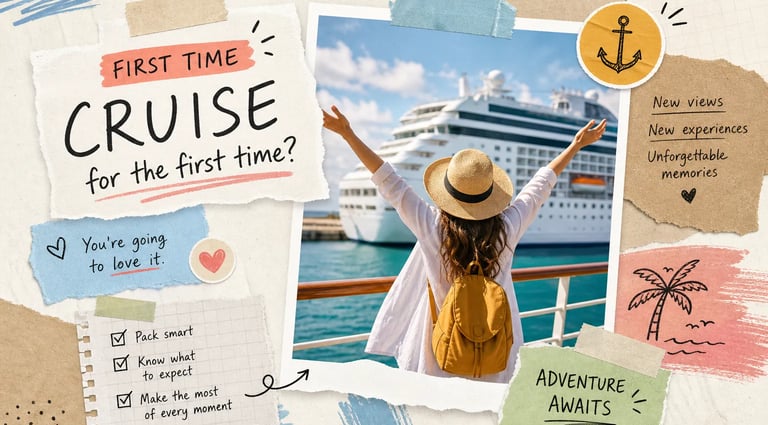
First-time cruise advice: the complete beginner's guide
First-time cruise advice tends to start with the same mental model: a cruise is like a floating hotel, you pay, you arrive, and everything is taken care of. That picture is mostly true, but important differences remain, and those gaps are where the surprises live. A cruise ship is not a floating hotel. It is a self-contained world with its own social rhythms, unwritten etiquette, hidden pricing layers, and a boarding process that will leave without you if you're late. The gap between what first-time cruisers expect and what they actually encounter is where the stress, the overspending, and the regret tend to cluster.
This guide closes that gap. By the time you finish reading, you won't just have a packing list. You'll understand how a cruise actually works: from choosing the right ship and cabin, to budgeting honestly for the extras, to stepping off at your final port without incident. If you'd rather hand the entire process to someone who has navigated it many times before, the team at Skylord Cruise and Holidays is here to help. From selecting the right itinerary to sorting the boarding-day logistics, they take the unknowns out of the equation so you can focus on the experience itself. But first, the decision that shapes everything else: which cruise are you actually getting on?
First-time cruise advice: choosing the right ship and cabin for your first sailing
Choosing a cruise is not primarily a booking task. It is a self-knowledge exercise. The wrong ship for your personality will feel more like a floating shopping mall than an adventure, and the wrong cabin choice can turn what should be a luxury into a source of daily frustration. The mental model that serves first-timers best is this: match the ship to the experience you actually want, not to the one that looks most impressive in photographs.
Matching ship size, itinerary length, and destination to your comfort level
A shorter sailing, a long weekend to five nights, for instance, is often recommended as a sensible first test. It gives you enough time to find your sea legs and understand how life onboard works, without committing to two weeks on a vessel you may not enjoy. Mega-ships offer a staggering range of activities, restaurants, and entertainment, but they can feel impersonal. Smaller ocean ships and river cruises offer a more intimate atmosphere where you actually get to know fellow passengers. For destinations, the Mediterranean and Caribbean are popular entry points for first-timers: port days tend to be frequent, itineraries are well-worn and well-supported, and the sailing conditions are generally kinder than on transatlantic or polar routes. Save back-to-back sailings and ultra-long voyages until you know you genuinely love the experience.
Cabin categories explained: inside, outside, balcony, or suite?
There are four main cabin types, and each comes with honest trade-offs. An inside cabin has no window and no natural light. It is also the cheapest option, quieter for sleeping, and perfectly comfortable for travellers who plan to spend most of their time elsewhere on the ship. Many seasoned cruisers book inside cabins by choice, precisely because they know where they'd rather spend their money. An outside cabin adds a porthole, giving you natural light and a sense of where you are without the cost jump. A balcony cabin adds private outdoor space, which becomes genuinely valuable on scenic itineraries like Alaska or Norway, where you may want to step outside at 6am to watch a glacier without getting dressed. A suite makes financial sense only when the included perks, such as a dedicated restaurant, priority boarding, and butler service, genuinely offset the premium cost.
For a first cruise, resist the instinct to overspend on the cabin. The ship itself is the experience. Skylord Cruise and Holidays can match your cabin choice to your sailing length, destination, and budget so the decision feels informed rather than like a gamble taken in a booking form at midnight.
What to pack, and the rookie mistakes that catch new cruisers out
Here is the single most counterintuitive piece of first-time cruise advice on packing: your checked luggage will often arrive hours after you board, delivered by the ship's crew while you're exploring the pool deck or finding your way around. Everything you need for the first few hours of your holiday needs to be in your carry-on bag. This sounds obvious once you know it, and yet it is one of the most common and preventable first-cruise regrets.
First-time cruise advice: carry-on and packing essentials
Your carry-on should contain your passport and boarding documents, all prescription medication, your phone charger, swimwear, sunscreen, a change of clothes, and any valuables. Without your swimwear and sunscreen in your hand luggage, embarkation afternoon becomes a waiting game, and embarkation afternoon is one of the most enjoyable parts of any sailing. The ship will sail, the pool will open, and your checked bag will still be somewhere in the terminal being sorted.
What cruise lines won't let you bring on board
The prohibited items list is longer than most first-timers expect. Candles and incense are banned on virtually every cruise line, as are clothing irons, steamers, and kettles, since they are fire hazards in a confined space. Extension cords with surge protectors are restricted on many lines. Alcohol and large coolers are prohibited on several major operators. Weapons, flammables, and controlled substances are absolute non-starters regardless of which line you sail with. The other mistake in this category is overpacking. Cruise cabins are compact, dress codes are more relaxed than new cruisers tend to assume, and a second suitcase of "just in case" clothing is extra weight you'll carry through every port. For a helpful authoritative reference, consult a cruise line's published prohibited items list before you pack.
Dressing for sea days, formal nights, and shore excursions
Most modern cruise lines have significantly relaxed their dress codes, but smart-casual remains the evening norm for main dining rooms. Lines like P&O and Cunard still observe one or two formal nights per sailing, while Norwegian Cruise Line operates with no formal nights at all under its freestyle approach. Smart-casual means collared shirts and trousers for men, and dresses, skirts, or smart trousers for women. Shorts, flip-flops, and swimwear are generally not appropriate in dining rooms after dark. Shore excursion days call for comfortable walking shoes, a light layer for air-conditioned coaches, and reliable sun protection. Always check your specific cruise line's dress guidelines before you pack.
The real cost of a cruise: what's included and what isn't
A cruise looks like a single purchase. It behaves like a series of micro-decisions that compound, daily, into a substantially larger bill. Understanding the cost structure before you board isn't pessimism, it hands control back to you as a traveller.
Drinks, Wi-Fi, and gratuities: the numbers you need to know
For UK cruisers in 2026, the realistic planning ranges are as follows. Drinks packages run approximately £20, £80 per person per day depending on the line and whether you opt for a soft-drinks-only or full-alcohol tier. Wi-Fi costs roughly £10, £25 per person per day for basic-to-mid-tier access, with faster multi-device plans sitting at the higher end. Gratuities and service charges typically fall between £8, £20 per person per day, though some lines include these in the headline fare. Note that these ranges vary widely by line, itinerary, and currency, so always confirm the current figures directly with your operator before you sail. A separate and expensive trap is phone roaming at sea: the moment you leave port, switch your phone to aeroplane mode unless you have a pre-arranged roaming package. Surprise roaming bills from a single sailing have been known to run into hundreds of pounds.
Shore excursions and speciality dining: where the extras compound
Cruise-line shore excursions typically cost £40, £150 or more per person depending on the destination and activity. Speciality dining restaurants charge roughly £15, £50 per person per meal on top of the included main dining options. The practical strategy is to set a realistic daily extras budget before you sail, rather than making impulsive decisions on board where the context is deliberately designed to encourage spending. Booking popular excursions and speciality dining before your departure date, usually possible through the cruise line's app or website once you're booked, avoids sell-outs and sometimes comes with early-booking discounts. For an overview of common unexpected fees, see this guide to extra charges on cruise ships.
Embarkation day: the hours that set the tone for your whole cruise
Experienced cruisers call it the ultimate first-timer's mistake: flying to the departure port on the morning the cruise sails. Any delay, mechanical fault, or missed connection and the ship departs without you. The ship does not wait, not reluctantly, not as a matter of policy, but as a fundamental operational reality. Missing a sailing happens more often than first-timers expect, and it is entirely avoidable.
Why arriving the night before is non-negotiable
Arriving the evening before removes the risk entirely. It allows a relaxed morning, time to sort your luggage tags and boarding documents, and a calm start to what should be an exciting day. Book a hotel near the port and treat embarkation eve as the first night of your holiday. The cost of one night in a port hotel is trivial compared to the cost of missing your sailing.
Want to learn more about cruise ships? Read our other travel themed articles about cruising.
Online check-in, arrival windows, and what to expect at the terminal
Most major cruise lines open online check-in weeks before sailing, and some, including Celebrity Cruises, require it to be completed at least three days before departure. During check-in, you'll select an arrival time window, upload your passport, provide a selfie for facial recognition purposes, and register a payment card for onboard charges. Arriving outside your assigned window can mean being turned away until your slot opens, so respect the timing. At the terminal, expect a luggage drop with porters (with your cruise-issued luggage tags already attached), a security check, document verification, and then boarding when your group is called. Bring a printed or digital boarding pass and your luggage tags attached to every checked bag. For an updated checklist and the latest arrival-window guidance, see these cruise check-in rules for 2026.
Staying well at sea and making the most of every port stop
Two anxieties linger longest for first-time cruisers: seasickness and the fear of either missing the ship or wasting a port day. Both are manageable with the right preparation.
What actually works for seasickness prevention
Scopolamine patches, worn behind the ear and started before you sail, have the strongest clinical track record of anything currently available. For UK travellers, the most readily available over-the-counter alternatives include promethazine (sold as Phenergan) and cinnarizine (sold as Stugeron), both of which are effective when taken before symptoms begin. The critical rule with all of these options is the same: use them before you feel unwell, not after. Acupressure wristbands are popular but have weak clinical evidence. Ginger has mixed results across studies. Cabin placement matters independently: a midship cabin on a lower or mid-level deck experiences significantly less movement than one at the bow or on a high deck. If you're concerned about seasickness, that cabin location is worth prioritising at the booking stage. For a deeper look at the medical evidence and treatments, consult this review of seasickness information and treatment.
Shore excursions: booking smart and getting back on time
The core trade-off between cruise-line excursions and independent tours is straightforward. Cruise-line excursions cost more, but the ship waits if your tour runs late because of traffic or an unforeseen delay. Independent tours and third-party operators are often cheaper and more flexible, but if something goes wrong and you're delayed, the ship leaves on schedule regardless of where you are. For first-time cruisers at unfamiliar ports, the peace of mind offered by cruise-line excursions is worth considering. At ports you've researched thoroughly, independent exploration or reputable third-party tours can offer better value and a more authentic experience. Always aim to be back at the ship at least 30 minutes before the published all-aboard time, and keep the ship's local port agent emergency number saved on your phone.
Ready to sail with confidence?
A cruise stops feeling complicated the moment you understand how it actually works. With this first-time cruise advice in hand, you can step on board knowing the rules of the game: choose a ship that suits your travel style, pack your essentials in your carry-on, build an honest budget for drinks, Wi-Fi, gratuities, and excursions, and arrive at the port the night before without exception. Do those things and the experience can focus entirely on what it's supposed to be, enjoyable, expansive, and genuinely memorable.
That leaves one final variable: the planning itself. At Skylord Cruise and Holidays, About us, the team handles everything from finding the right itinerary and cabin to managing the booking logistics, so you arrive at the port focused on the experience rather than the paperwork. Whether you're considering your first short Mediterranean sailing or a longer Caribbean adventure, get in touch and let us help you plan a cruise you'll actually love from the moment you step on board.
The Powerful Blog © 2026
The Powerful Blog informs and inspires the generation of today and tomorrow through honest insights, emerging trends, and meaningful stories that shape our understanding of the world.
Reframe your inbox
Subscribe to our newsletter and never miss a blog.
We care about your data in our privacy policy.